
User Journey and Gamification-Focused Service Design in B2C Online Education Platforms
Introduction
One of the most critical success metrics for B2C online education platforms is not only to attract the user to the platform but also to keep them on the platform with continuous and meaningful interaction. In this context, user retention requires holistic alignment of user experience (UX), service design, and technological infrastructure as much as pedagogical content quality.
This article discusses the user journey, service design decisions, technical architecture (tech stack), and future scalability vision of a modular online education platform built on gamification principles.
User Journey Design
1. Onboarding: Quick Understanding, Low Barrier
The user journey begins at the moment of first entry to the platform. The main goal at this stage is:
- For the user to clearly understand what to do.
- To experience the first sense of success as early as possible.
Accordingly, the onboarding process is designed with the following principles:
- Quick guidance based on level, topic, or goal.
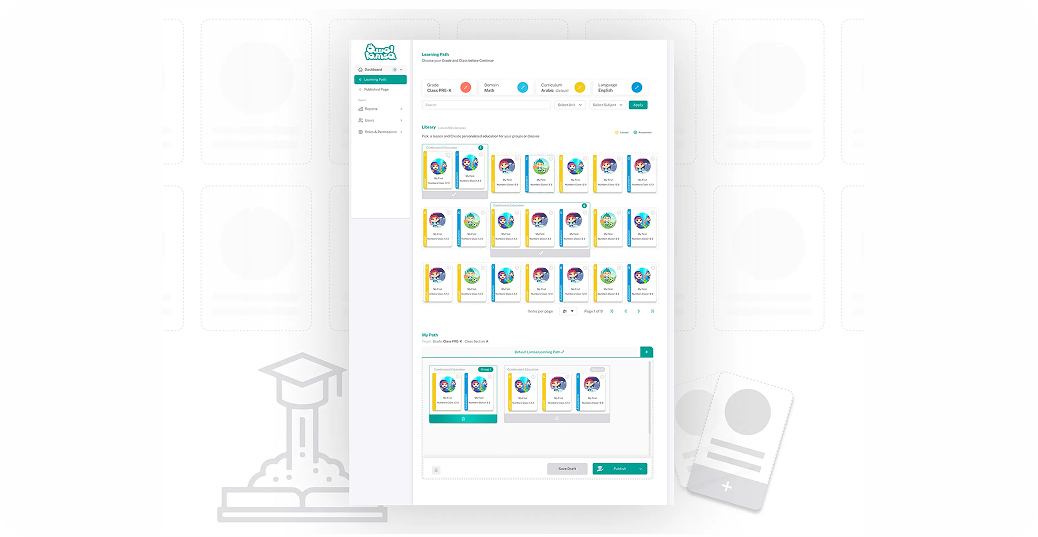
- Visually simple, card-based content presentation.
- The “Start” action is always visible and accessible.
2. Discovery and Content Selection
An information architecture approach aiming to minimize cognitive load has been adopted in interface design. Content is presented as follows:
- Card structure.
- Color-coded categories.
- Visual cues showing progress status.
Thanks to this structure, the user:
- Quickly grasps the scope of the content.
- Can choose modules suitable for their level.
- Does not experience the feeling of “Getting lost” within the platform.
3. Learning Process and Micro-Achievements
The learning experience, forming the core of the platform, aligns with modern learning habits rather than classic long lectures:
- Micro-content.
- Short tasks.
- Instant feedback.
Gamification elements come into play here, triggering the user's dopamine loop:
- Visual progress bars for each completed module.
- Badges and level systems.
- Daily / weekly goals.
4. Retention Mechanisms
Sending notifications alone is not enough to keep the user on the platform. Behavioral Design principles have been applied in this platform:
- Personalization: Content suggestions specific to interests.
- Reminders: Smart notifications for unfinished modules.
- Loss Aversion: Level systems creating a feeling of progress loss.
- Sense of Investment: Collection logic making the time spent by the user valuable.
Service Design Perspective
The platform is treated not just as an interface but as an end-to-end service. Key points considered during the design process include:
- Interaction Maps: Planning the flow between user, content creator, and system.
- Edge-Case Scenarios: Managing situations like abandonment, re-entry, device change.
- Scalability: Content management (CMS) being suitable for growth.
- Feedback Loops: Continuously improving the product by embedding analytical data into the service.
Technical Architecture and Tech Stack
The platform's technical infrastructure is constructed with flexibility and scalability in mind.
Example Tech Stack Approach
-
Frontend
- React / Next.js: SEO compatible and fast rendering capability.
- Component-Based UI: Reusable design system.
- State Management: Global state control with Redux or Zustand.
- Responsive: Accessible design on all devices.
-
Backend
- Node.js / NestJS: Modular and testable server architecture.
- API: Flexible data communication with REST or GraphQL.
- Microservices: Independently scalable service structure.
-
Data Layer
- PostgreSQL: For relational data (User, Course, Payment).
- Redis: For cache mechanism and session management.
- NoSQL: For event tracking and logging (optional).
-
Gamification & Analytics
- Event-based Tracking: Instant tracking of user movements.
- Segmentation: Grouping according to user behaviors.
- A/B Testing: Infrastructure to measure the success of features.
Future Vision and Expansion Areas
Steps to transform the platform from just an "educational app" into a sustainable ecosystem in later phases:
- Artificial Intelligence (AI): Personalized content and exam suggestions.
- Adaptive Learning: Paths adjusting the difficulty level according to the user's speed.
- Social Learning: Leaderboard, group tasks, and community features.
- Multi-Platform: Integration with Mobile, TV, and Wearable technologies.
Conclusion
Designing a gamified, retention-focused B2C online education platform becomes possible at the intersection of not just an aesthetic interface, but behavioral science, service design, and a robust technical infrastructure.
The structure discussed in this study represents a product approach that puts the user at the center, is measurable, developable, and scalable in the long run.